Manuscripts and Memorabilia of Konstanty Laszczka at the National Library of Poland
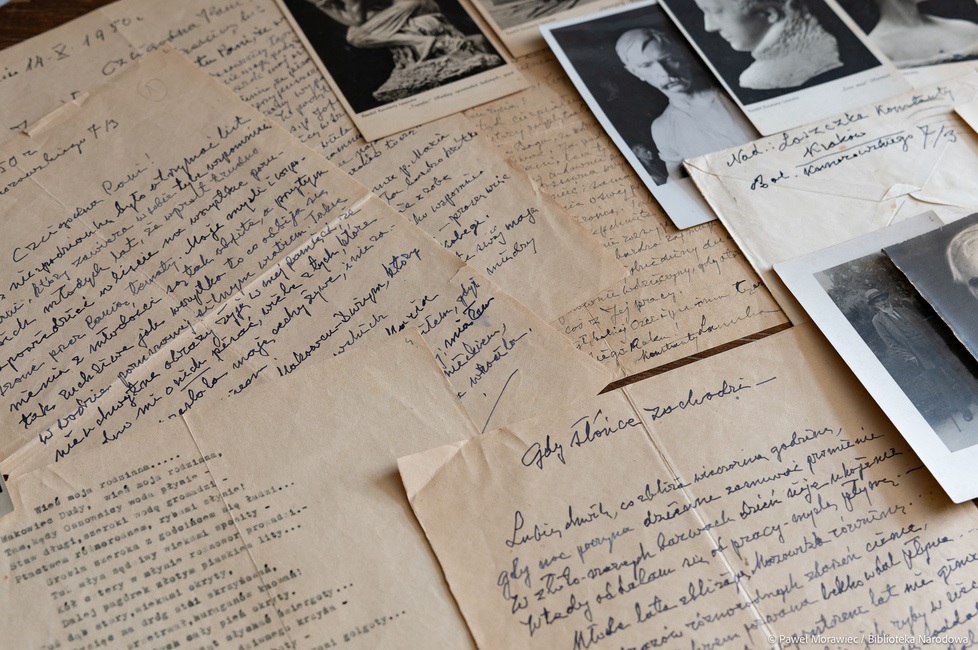
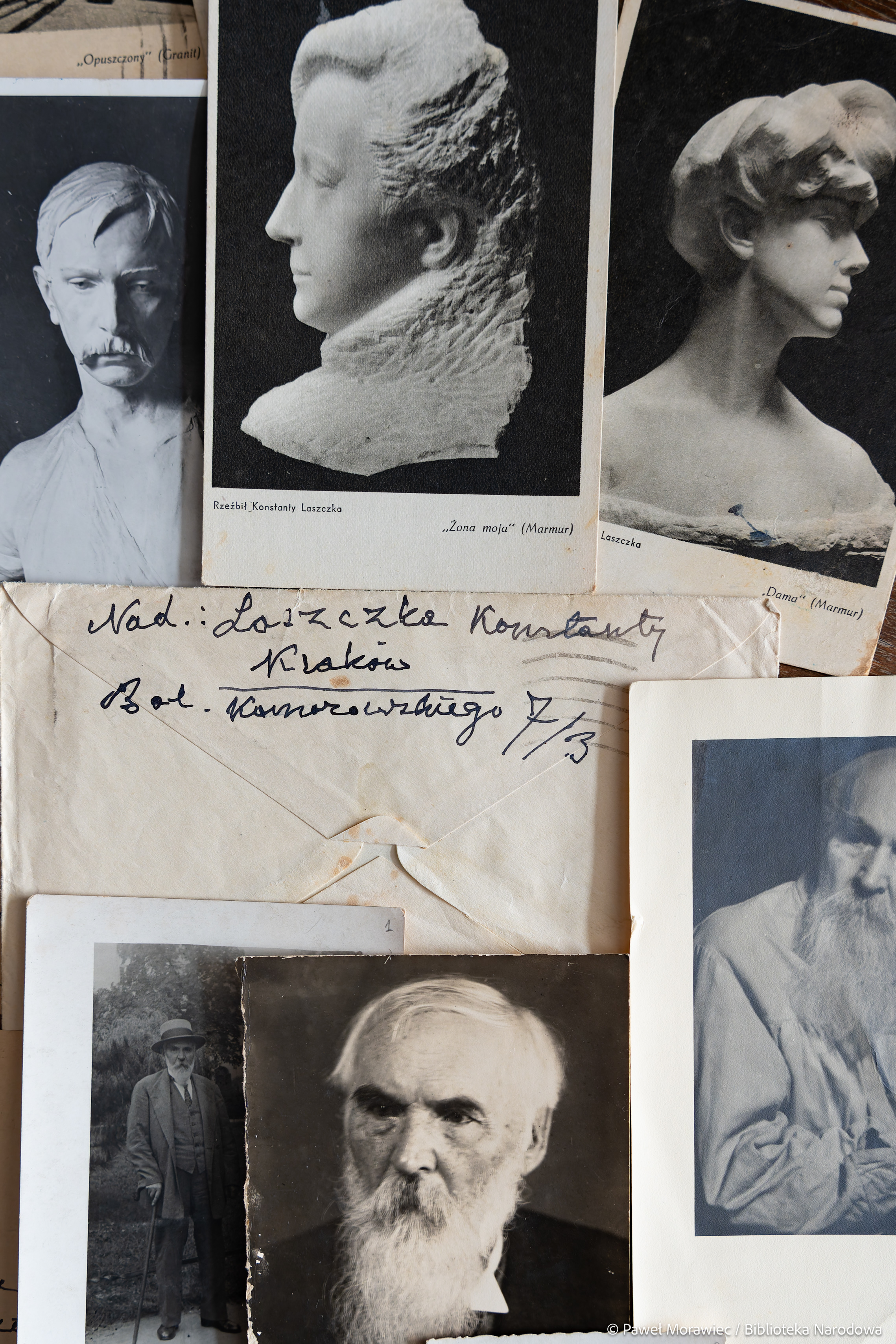
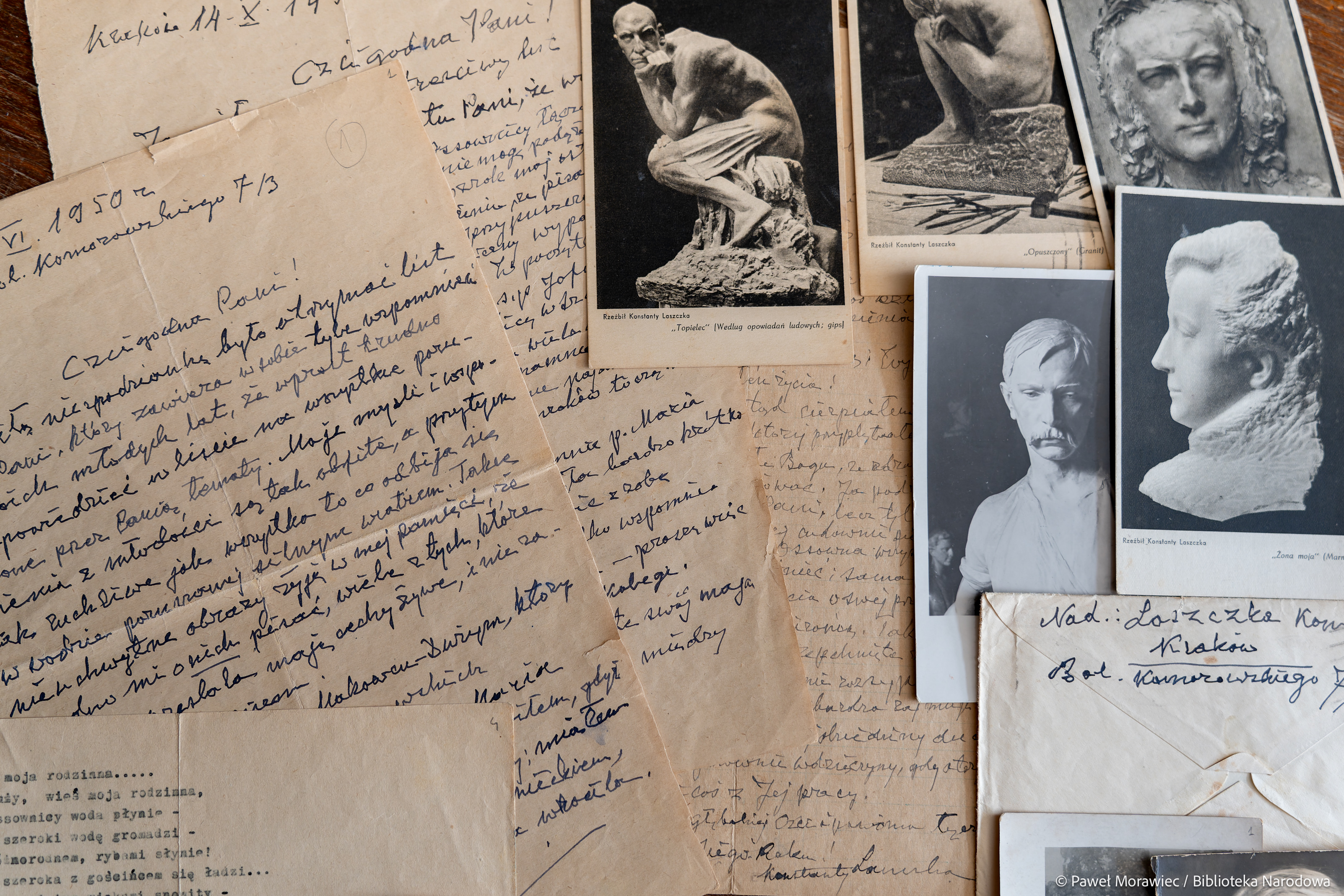
The National Library of Poland has received from Krystyna Piórkowska a donated collection of materials relating to the sculptor and painter Konstanty Laszczka. The archive comprises letters, photographs, and documents connected with the artist. It includes archival materials directly concerning Laszczka’s life and work, among them 43 letters, family photographs, reproductions of artworks, manuscripts of poems, and press cuttings. The documents are held in the Manuscripts Department and are available under the following call numbers: Rps 18654 III, Rps 18655 III, Rps 18804 I, and Rps 18805 IV.
Konstanty Laszczka (1865–1956) was one of the leading figures in Polish sculpture at the turn of the twentieth century and among the artists who helped shape its modernist form. Born in Makowiec Duży in the Mazovia region, he studied at the School of Fine Arts in Kraków before continuing his artistic training in Paris, where he encountered the most important artistic movements of the period. This experience played a significant role in shaping his formal language, which occupied the intersection of academic realism, symbolism, and Art Nouveau tendencies. Laszczka’s oeuvre encompasses portrait, monumental, and funerary sculpture, as well as medal-making and artistic ceramics. Sculptural portraits occupy a particularly important place in his work. In them, he sought not only to reproduce the sitter’s physical appearance faithfully, but also to capture their psychological character and individual expression. Art education was another important area of Laszczka’s activity. As a professor at the Academy of Fine Arts in Kraków, he exerted a significant influence on successive generations of sculptors and contributed to the institutional development of modern art education in Poland.
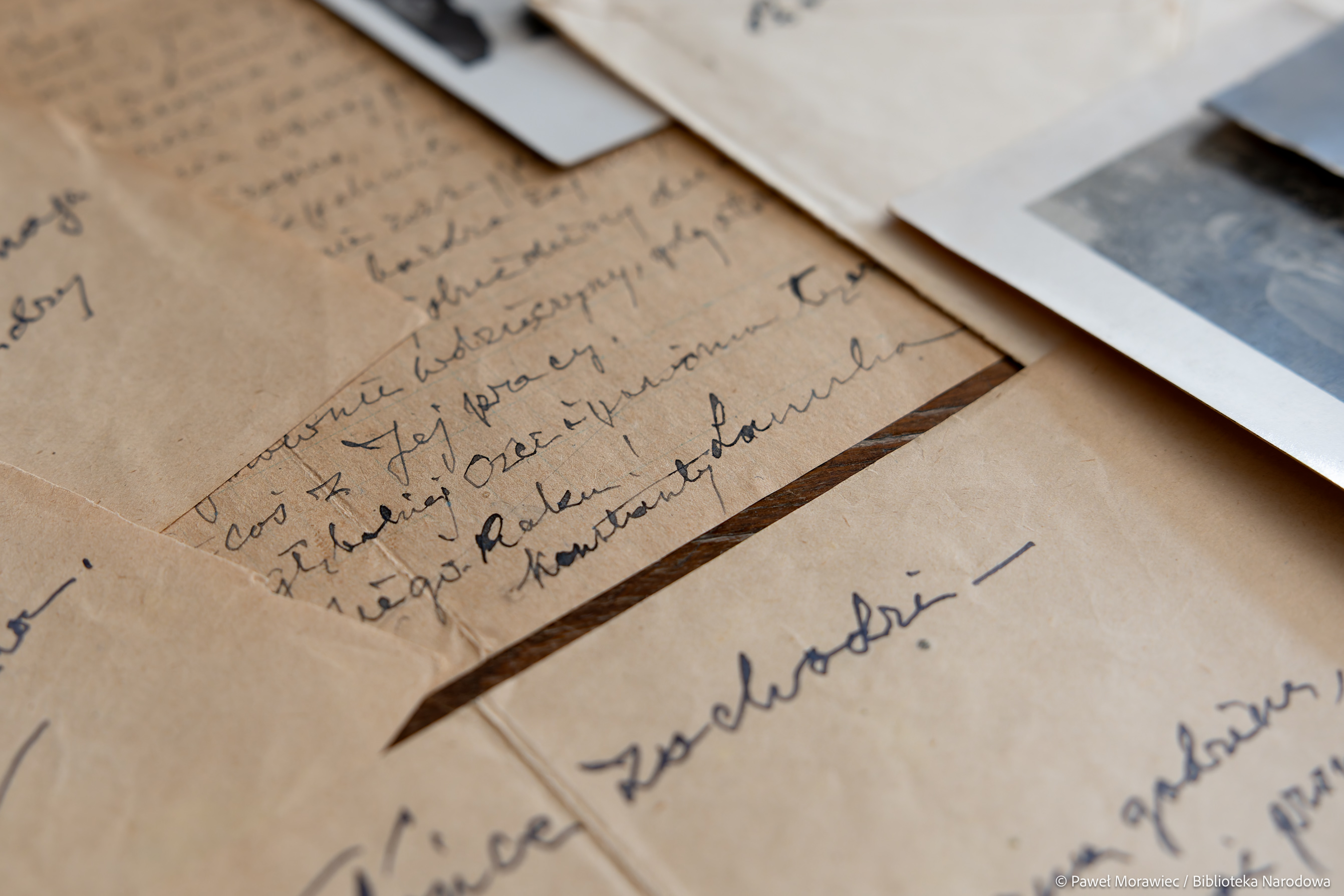
The most important part of the newly acquired collection is the correspondence dating from 1950 to 1956, sent from Kraków to Stanisława Ciemniewska in Mława. It includes letters and postcards written by the artist himself, as well as letters addressed to the same recipient by his daughter, Jadwiga Wierzbiańska. Laszczka’s earliest letters were written in his own hand. Over time, however, as his eyesight deteriorated, his handwriting became increasingly difficult to read. From 1953 onwards, the correspondence was written primarily by his secretary and daughter, while Laszczka merely added his signature. Later, Jadwiga Wierzbiańska provided updates on her father’s condition or wrote on his behalf. The correspondence continued after the sculptor’s death, and the collection also contains three letters written by his daughter between 1956 and 1958, bearing witness to the warm relationship between Wierzbiańska and Ciemniewska.
The correspondence is distinctly personal and reflective in character. Laszczka writes about his health and family circumstances, recalls his youth, and evokes the figures of old acquaintances. The correspondents were connected by their shared place of origin and their memories of their home town and its inhabitants. The letters also contain discussions of personal interests, including chiromancy, graphology, telepathy, and the spiritual world in a broader sense.
In a letter dated 17 March 1952, Laszczka briefly summarises his artistic achievements and mentions the loss of approximately 180 of his poems, which disappeared when his publisher’s premises were destroyed. The letters also contain references to Lucjan Rydel, Leon Schiller, Leon Wyczółkowski, and Julian Fałat. They additionally include poems by the artist, such as By the Osownica, Time, The Sculptor, and Flight of the Spirit.
The letters offer a moving portrait of Laszczka’s final years and his gradual withdrawal from creative activity. The artist writes of suffering, weakness, and his inability to continue painting and sculpting. His daughter’s correspondence is dominated by accounts of her father’s deteriorating physical and mental condition. Of particular value is an extensive six-page letter written by Jadwiga Wierzbiańska on 15 June 1956. It recounts the final moments of Konstanty Laszczka’s life and offers a detailed reflection on the death of an artist, father, and friend.
The remaining materials in the collection were probably enclosed with the correspondence. They comprise eight texts by Laszczka, including seven poems. Two of these, Poseidon and When the Sun Sets, survive in manuscript. There is also a typescript of the poem My Native Village, bearing a handwritten dedication from 1951, four other typescript poems, including The Sea and To Polish Airmen – the latter preserved in two copies – as well as a fragment of prose entitled The Origin of the Linden Tree, with a dedication dated 1952. The poetic dimension of Laszczka’s work, together with his custom of enclosing poems as gifts for the recipient, reveals his profound sensitivity and his inclination to express himself through refined language.
The collection also contains five photographs. Two portray Konstanty Laszczka himself, while another is a photographic image of his sculptural self-portrait. All three bear either a dedication or the artist’s signature. The remaining photographs show Laszczka with members of his family – his son and daughters. The collection is supplemented by seven postcard reproductions of the artist’s sculptures.
The archive is completed by press cuttings. These include articles written by Laszczka himself in the 1920s and 1930s, among them Conversations on Art and the School and A Few Words on Sculpture and Its Development, as well as materials relating to the artist’s jubilee in 1955 and texts published after his death in 1956. Notes written in the margins in Stanisława Ciemniewska’s hand suggest that she had been collecting information about Laszczka long before the two began exchanging letters.
Beyond its documentary significance, the correspondence from the final years of the artist’s life reveals something deeper: an intimate record of a friendship between two people. Laszczka’s epistolary relationship with Stanisława Ciemniewska was not merely a means of exchanging factual information. It bears witness to a need for closeness, remembrance, and the experience of being heard at a time when his strength and eyesight were failing and his world was shrinking to the four walls of his home. Laszczka’s trembling handwriting, increasingly difficult to decipher; his daughter’s poignant accounts of her father’s decline; and the letters written after his death preserve a universal image of the final stage of human life – with its loneliness, dignity, longing for the past, and quiet acceptance of the inevitable.
These documents are therefore more than archival materials. They demonstrate that even in the final years of his life, blind, weakened, and separated from his studio, the artist remained a person searching for human contact and meaning – and that the person on the other side of the correspondence needed that connection as well.
Since 2019, the holdings of the National Library of Poland have also included a plaster bust by Konstanty Laszczka, donated by Teresa and Jan Marcin Korzeniowski together with their family archive.