A Letter By Ignacy Jan Paderewski In The Collection Of The National Library Of Poland
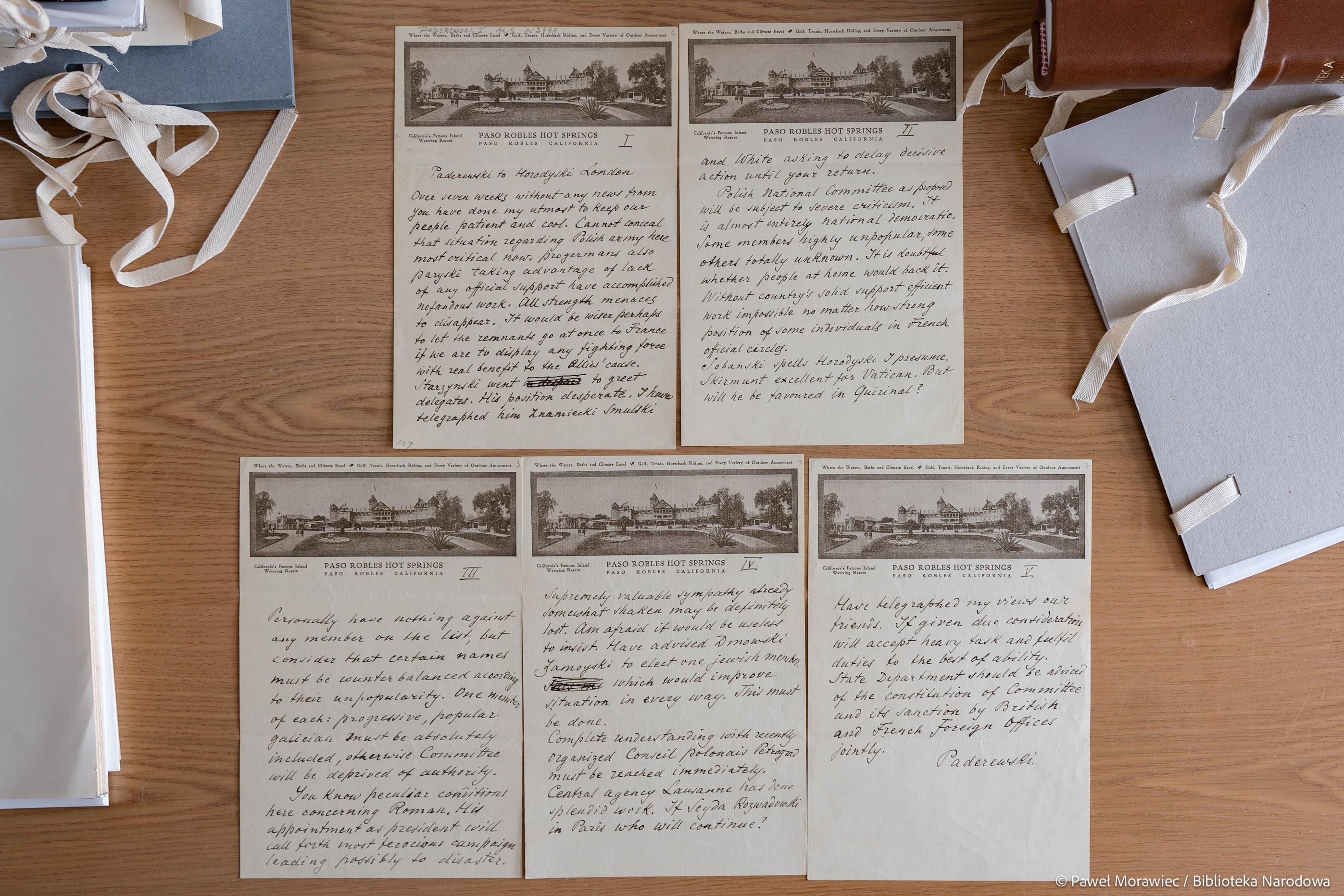
Thanks to a generous donation from Krystyna Piórkowska, the National Library of Poland has acquired the manuscript of a letter written by Ignacy Jan Paderewski to Jan Horodyski (1881–1948), a diplomat, émigré activist and informal liaison between the British and American intelligence services and the Polish side. The five-page autograph manuscript, written by Paderewski in late August or early September 1917 and held at the National Library under the callnumber Rps 18806 II, is a unique document revealing the behind-the-scenes struggle for the Polish cause in the United States during the First World War. It also records a pivotal historical moment: Paderewski’s decision to enter high-level politics officially.
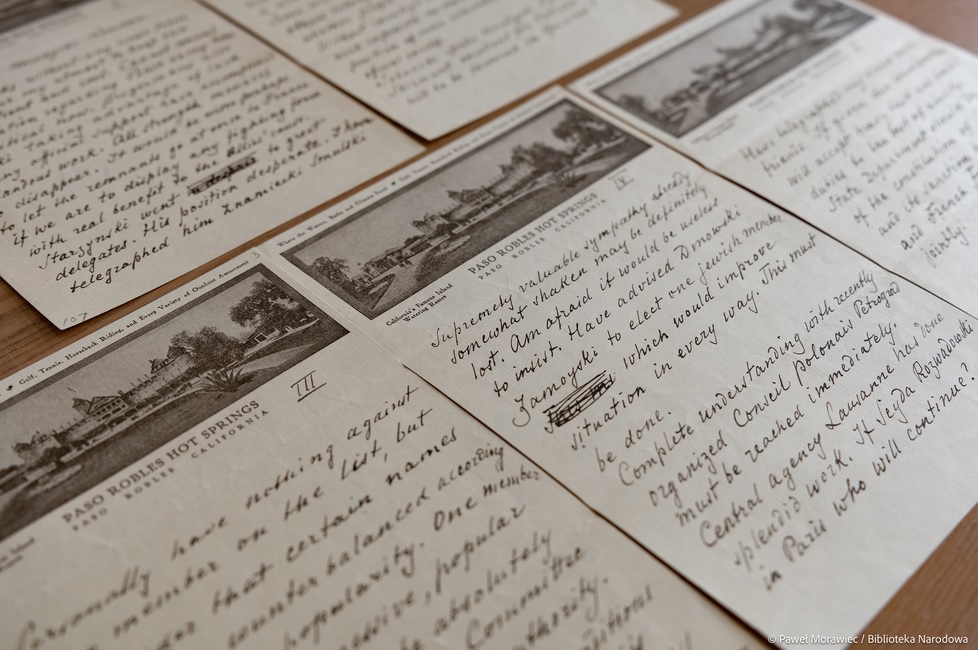
Written on the letterhead of the luxurious Paso Robles Hot Springs resort in California, which Paderewski visited repeatedly to treat his arthritis in its therapeutic thermal waters, the letter is a handwritten draft of a political dispatch or telegram. This is indicated by its deletions and corrections, the absence of conventional greetings and closing formulas, and the fact that it was written in English. A secretary would subsequently type such a text, encode it and send it from a telegraph office, as may be inferred from the heading written on the first page of the letter.
The document’s first page presents a dramatic assessment of the situation of the Polish military effort in North America, outlining the recruitment crisis affecting the future Blue Army, caused by the lack of support from the Allies. Ignacy Jan Paderewski calls for the immediate evacuation of the volunteers to France, while also pointing to the destructive activities of the opposition, including Antoni A. Paryski, and to the desperate position of Dr Teofil Starzyński. In the following section, the author focuses on a critical analysis of the newly proposed composition of the Polish National Committee (PNC). In Paderewski’s view, the Committee was too politically one-sided, being dominated by the National Democrats, and would not gain international authority without broader public support in Poland. He mentions consultations with the diplomat Henry White aimed at delaying final decisions and analyses the PNC’s strategic diplomatic appointments in Europe, including Władysław Sobański in London and Konstanty Skirmunt. Paderewski accurately anticipated the difficulties the latter would face in navigating between the Vatican and the anticlerical Italian government at the Quirinal.
The text illustrates the immense political and organisational tensions faced by Paderewski’s committee in America shortly before the ultimate diplomatic success of the Western powers’ official recognition of Poland’s independence. It reveals the difficulties behind the scenes: the growing impatience of the Polish diaspora, resistance from internal opposition groups and the dramatic struggle to sustain the volunteers’ fighting spirit.
The letter demonstrates Paderewski’s profound diplomatic instinct as he attempted to preserve national unity and prevent a split within the Polish émigré community. The political situation in August and September 1917 was extremely tense. The pro-independence left and moderate circles accused Roman Dmowski of seeking to take authoritarian control of the entire Polish diplomatic effort. Paderewski understood perfectly well that if Dmowski formally became president of the PNC, it would provoke a “ferocious campaign” in the United States and destroy the diplomatic achievements secured thus far. As a result of this warning, although Dmowski did in fact direct the work of the PNC in Paris, it was Ignacy Jan Paderewski who became the Committee’s official representative in the United States.
The fifth and final page of the document forms the conclusion and summary of this exceptionally important political telegram. It contains Paderewski’s personal declaration and a crucial diplomatic instruction, followed by his original signature. In one paragraph, the composer makes a declaration that proved decisive for his entry into official high-level politics: “If given due consideration will accept heavy task and fulfil duties to the best of ability.” Paderewski agreed to assume official leadership of the Polish cause in the United States, but only on condition that Dmowski and the other Committee members took his earlier warnings into account.
The final sentence of the instruction sets out a precise course of action towards the United States government: “State Department should be advised of the constitution of Committee and its sanction by British and French Foreign Offices jointly.” Paderewski knew that the most effective way to obtain recognition from Washington was to demonstrate that the European Allies had already formally recognised and supported the PNC in Paris.
The manuscript reveals the dramatic struggle to secure recognition for the future Blue Army and Paderewski’s criticism of the Polish National Committee, while also proposing a strategy for strengthening Poland’s position on the international stage. It is of immense historical value to Polish collections, offering a unique insight into the decision-making process of one of the fathers of Polish independence. It reveals the inner workings of his diplomacy and provides exceptionally rare and direct evidence of how thoroughly Paderewski understood the political realities of the Western world.