Obraz Żupy Wielickiej i miasta Wieliczki
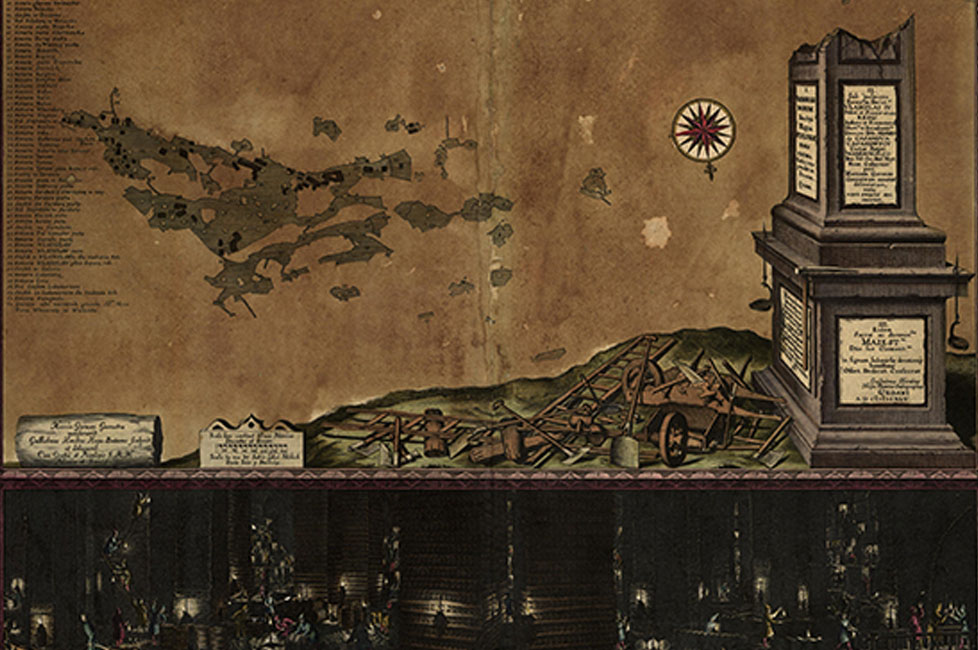
Wilhelm Hondius, Obraz Żupy Wielickiej i miasta Wieliczki
Jeden z czterech sztychów wykonanych w Gdańsku przez słynnego rytownika i kartografa Wilhelma Hondiusa, przedstawiających plany górnicze sporządzone na podstawie pomiarów geodezyjnych przeprowadzonych przez geometrę Marcina Germana. Pochodzący ze Szwecji German został sprowadzony do Polski w roku 1620 przez żupnika Adama Górskiego i zatrudniony jako sztygar w wielickiej kopalni. W roku 1638 nakreślił trzy plany żup solnych i plan miasta Wieliczka w skali 1:1266. W 1645 roku Wilhelm Hondius wyrytował te plany w nieco zmienionej skali (1:3800) i uzupełnił scenami ilustrującymi pracę górników, szczegółowo odtwarzając wygląd trzech poziomów kopalni, szybów, chodników, używanych narzędzi i urządzeń. Wykonanie sztychów zlecił marszałek nadworny koronny Adam Kazanowski, pełniący w latach 1642–1647 funkcję administratora żup wielickich.
Widoczny u góry ryciny plan Wieliczki, na którym odwzorowano wszystkie najważniejsze budowle, ozdobiony został herbem miasta (posułt między dwoma kilofami). Z lewej strony umieszczono kartusz z dedykacją dla króla Władysława IV i pięciopolową tarczę z herbem królewskim. Niżej, przy obelisku, widnieje grupa postaci, wśród których badacze dopatrują się wizerunku samego Marcina Germana. Z prawej – kartusz z dedykacją dla marszałka Adama Kazanowskiego. Poniżej planu panoramiczny widok przedstawiający naziemne budynki kopalni. Z lewej – konny kierat służący do wydobywania soli z szybu. W szopie za nim trwa sprzedaż i załadunek soli. Na pierwszym planie widoczny rynnociąg solankowy. Pośrodku zadaszona warzelnia z wodolejami pracującymi przy zbiornikach solanki, łopatnikami mieszającymi solankę w wielkiej murowanej panwi i palaczami rąbiącymi drwa na ogień. Z prawej strony dwaj mężczyźni transportują sól w charakterystycznych stożkach do widocznej obok suszarni, skąd wysuszona sól jest odbierana przez nabywców i ładowana na konne wozy.
Pochodzący z kolekcji pułkownika Romana Umiastowskiego sztych trafił do zbiorów BN w 1984 roku. Jest jednym z dwóch zachowanych kolorowanych egzemplarzy rycin Hondiusa(drugi komplet znajduje się w zbiorach Muzeum Polskiego w Rapperswilu).
Zobacz obiekt online w bibliotece cyfrowej polona.pl.
Willem (Wilhelm) Hondius, Image of Wieliczka Salt Mine and the city of Wieliczka
One of four engravings made in Gdańsk by the famous engraver and cartographer Willem Hondius, depicting plans of the mine based on geodetic measurements made by the surveyor Marcin German. Marcin German, who was originally from Sweden, was brought to Poland in 1620 by the salt mine manager Adam Górski and employed as a foreman at the Wieliczka Salt Mine. In 1638, he drew up three plans of the mines and a map of the town of Wieliczka on a scale of 1:1266. In 1645, Hondius engraved these plans on a slightly modified scale (1:3800) and added scenes illustrating the work of the miners, reproducing in detail the appearance of the three levels of the mine, the shafts, galleries, tools and equipment used. The engravings were commissioned by the Royal Marshal Adam Kazanowski, who served as administrator of the Wieliczka Salt Mines from 1642 to 1647.
The map of Wieliczka, visible at the top of the engraving, depicts all the most important buildings. It is decorated with the city's coat of arms – three miner’s hammers. On the left, there is a cartouche with a dedication to King Władysław IV and a five-part shield with the royal coat of arms. Below, next to the obelisk, there is a group of figures including one that researchers believe to be Marcin German himself. On the right, there is a cartouche with a dedication to Marshal Adam Kazanowski. Below, there is a panoramic view of the surface buildings of the mine. On the left, there is a horse-drawn treadwheel used to extract salt from the mine shaft. In the shed behind it, salt is being sold and loaded onto carts. In the foreground, a brine trough is visible. In the centre, there is a roofed boiling house with people working at the brine tanks, mixing the brine in a large brick basin and chopping wood for the fire. On the right, two men are transporting salt shaped into characteristic cones to the drying house visible in the background, from where the dried salt is collected by buyers and loaded onto horse-drawn carts.
From the collection of Colonel Roman Umiastowski. The engraving was added to the National Library’s collection in 1984. It is one of two surviving coloured copies of engravings by Hondius (the other set is in the collection of the Polish Museum in Rapperswil).